
Moisture on the room-side surface, dew on the exterior, and fog trapped between two panes can look similar from across the room, but they point to very different causes. Replacing a window for the wrong type of condensation can waste money without fixing the underlying problem.
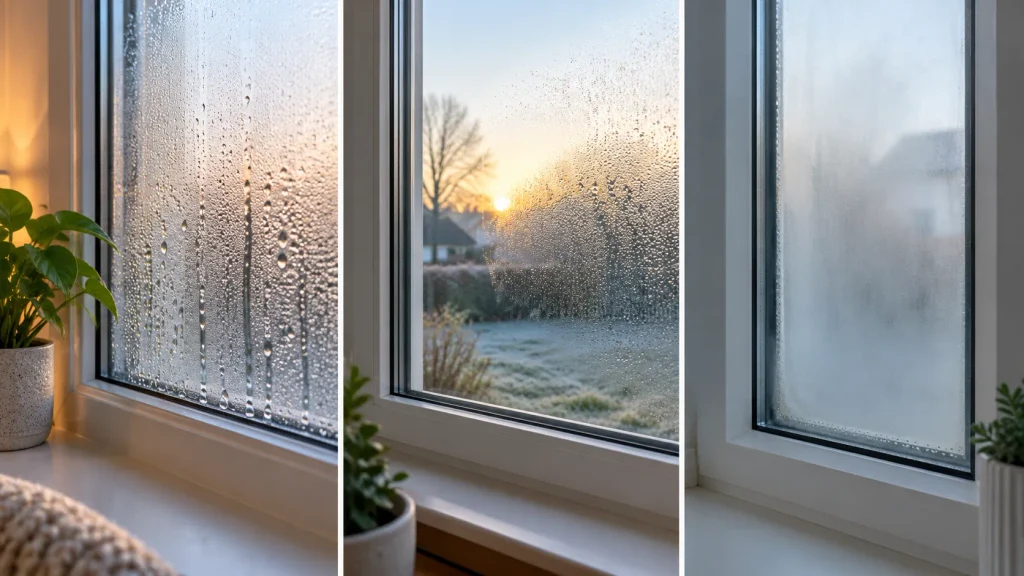
Condensation on the inside of the window
Interior condensation forms when humid indoor air reaches a glass or frame surface that is cold enough to fall below the air’s dew point. The higher the indoor relative humidity and the colder the surface, the easier condensation can form.
That means a wet interior pane does not automatically indicate failed glass.
Start with the room conditions. Cooking, showering, drying clothes indoors, inadequate extraction and low air exchange can all raise indoor humidity.
Look at airflow too. Heavy blinds or curtains can reduce warm room air movement over the glass and make a cold surface more prone to condensation.
If moisture repeatedly runs onto timber trim, drywall or the sill, deal with it rather than treating it as harmless winter fog. Persistent wetting can damage surrounding finishes even when the insulating glass unit itself is intact.
Condensation on the outside
Exterior condensation is often a weather event rather than a window defect.
A high-performing insulating unit can keep so much indoor heat away from the outer pane that the exterior glass becomes cool enough for humid outdoor air to condense on it. FGIA notes that exterior condensation can occur on high-performance products, while ENERGY STAR explains that warm, humid weather combined with a cooled outer surface can produce the same effect.
It commonly appears in the early morning and disappears as the glass warms.
Before doing anything to the window, verify that the moisture really is on the exterior surface. If it wipes off from outdoors and there is no water entering the frame or wall, a replacement window is rarely the first response.
Fog or moisture between the panes
This is the one that changes the diagnosis.
In double- or triple-glazed insulating glass, moisture that is genuinely trapped between the panes usually indicates that the sealed insulating glass unit has lost its seal and allowed moisture into the cavity. Pella identifies between-pane condensation as a typical sign of insulating-glass seal failure.
Confirm the location before ordering anything.
Clean or wipe the accessible interior and exterior glass surfaces. If the haze remains and cannot be reached from either side, it is likely inside the sealed unit.
Depending on the window design, the remedy may be replacement of the insulated glass unit rather than the entire frame and window. If the frame, sash and hardware are also deteriorated, the scope can be larger.
What the pattern can tell you
A little morning dew outside is very different from water running down the inside of every bedroom window.
Interior condensation across several rooms points first toward indoor humidity and surface temperatures.
Condensation concentrated around the edges of the glass can reflect colder edge conditions.
Fog trapped inside one insulated unit while neighboring windows remain clear is much more suggestive of a problem with that particular sealed unit.
Water stains appearing around the wall or frame during rain are another issue altogether. That is water infiltration, not automatically condensation, and the installation, perimeter seal and drainage path need to be inspected.
A quick diagnosis table
| Where is the moisture? | Most likely direction to investigate | First response |
|---|---|---|
| Room-side glass | Indoor humidity + cold surface | Manage humidity, ventilation and airflow |
| Exterior glass | Outdoor dew conditions | Observe; usually no repair if it clears normally |
| Between sealed panes | Insulating-glass seal failure | Have the IGU/window assessed |
| Around frame during rain | Water infiltration/drainage | Inspect installation, seals and drainage |
When should you call a window professional?
Call when moisture is inaccessible between the panes, water is entering during rain, the sash or frame is damaged, or repeated interior condensation is causing deterioration around the opening despite reasonable humidity control.
Describe the location precisely.
“Foggy window” is vague. “The moisture is trapped between the two panes and cannot be wiped from either surface” gives the person inspecting it a much better starting point.
That single distinction can separate a humidity problem from a glass-unit replacement.