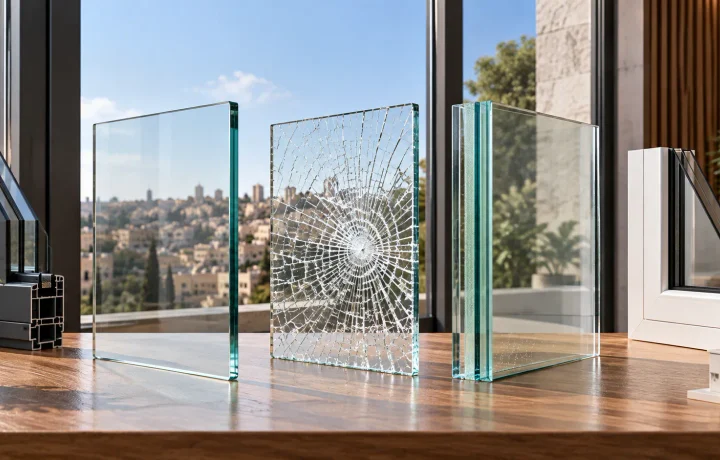
Start with two ratings: U-factor for heat transfer through the window, and SHGC for solar heat admitted through it. A lower U-factor generally means better resistance to heat transfer. For SHGC, the target depends on climate, orientation, shading and whether the building is primarily trying to reduce cooling load or benefit from solar gain.
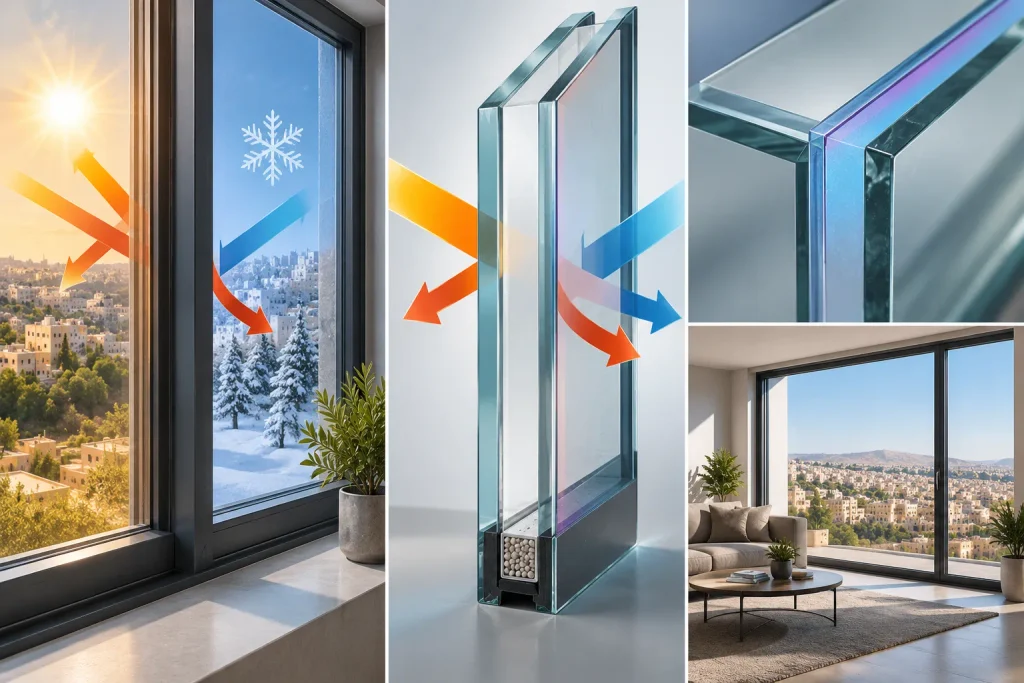
What is Low-E glass?
Low-E stands for low emissivity.
The coating is a very thin metallic or metal-oxide layer applied to a glass surface. Its job is to change radiative heat transfer, while the coating design can also affect solar heat gain and visible daylight.
Low-E does not mean the same thing as double glazing, tinting, reflective glass, tempering or an insulated frame.
Those features can be combined.
A project might use a double-glazed insulating glass unit with a Low-E coating, an air or argon cavity, tempered or laminated panes where safety requires them, and a frame selected around the opening and exposure.
That is a real specification. “Double glass Low-E” is only a label.
U-Factor, SHGC and VT measure different things
| Rating | What it tells you | General direction |
|---|---|---|
| U-Factor | Rate of heat transfer through the window | Lower means less heat transfer |
| SHGC | Fraction of solar heat admitted | Lower means less solar gain |
| VT | Visible light transmitted | Higher means more visible daylight |
NFRC reports these as separate ratings for a reason. Improving one characteristic does not automatically give you the solar or daylight performance you wanted.
A low U-factor is normally desirable where insulation matters.
SHGC needs more thought. In a hot or cooling-dominated project, lower solar gain is usually useful. In a cold design where useful winter sun is deliberately captured, a higher SHGC can sometimes be desirable. DOE makes the same climate distinction in its window-selection guidance.
What do Surface #2 and Surface #3 mean?
A conventional double-glazed IGU has four glass surfaces, counted from outside to inside:
Surface #1 — exterior face of the outer pane
Surface #2 — cavity face of the outer pane
Surface #3 — cavity face of the inner pane
Surface #4 — room-side face of the inner pane
Low-E coatings in sealed IGUs are commonly placed on protected cavity surfaces.
Coating position matters, but it should not be separated from the coating product itself.
Solar-control Low-E products are commonly configured on Surface #2, while passive Low-E products may be placed on surfaces of the inward lite. Technical guidance from Vitro and building-envelope guidance both illustrate this distinction.
Do not turn that into a universal rule saying “#2 is always for hot climates and #3 is always for cold climates.” Different coatings are engineered for different positions and performance targets.
Ask for the manufacturer’s build-up and rated performance.
Which Low-E direction suits the project?
| Project condition | Useful direction |
|---|---|
| Cooling-dominated climate | Low U-factor and lower SHGC |
| Strong east/west exposure | Solar control deserves high priority |
| Mixed climate | Balance U-factor, SHGC, shading and orientation |
| Heating-dominated design using winter sun | Low U-factor with carefully selected solar gain |
| Large unshaded glazing | Review SHGC before approving the glass |
External shading can also change the design decision. A well-shaded south-facing window is not the same problem as a large unprotected west-facing opening.
The room matters too. Bedroom comfort, shopfront appearance and a large living-room elevation may justify different glass even within the same building.
Do not specify Low-E without the actual glass build-up
A notation such as:
6 / 12 / 6 Low-E
still leaves unanswered questions.
Which pane carries the coating? What coating is it? Is the cavity air-filled or gas-filled? What is the SHGC? Is the U-factor quoted for the centre of glass or the complete window? Is safety glass required?
A stronger specification identifies:
- pane thicknesses;
- cavity width;
- Low-E product or required performance;
- coating surface;
- cavity gas where specified;
- spacer where relevant;
- U-factor;
- SHGC;
- VT when daylight matters;
- safety treatment where required.
This makes quotations comparable.
Without it, two suppliers can price completely different windows under the same “Low-E double glass” description.
Does the frame still matter?
Very much.
The glass is only part of the window. The finished unit includes the frame, sash, spacer edge, gaskets or brushes, hardware, drainage, perimeter joint and installation into the wall.
Metal frames deserve particular attention to thermal design because metal conducts heat readily. DOE specifically notes the value of thermal breaks in reducing conductive heat flow through metal window frames.
When comparing aluminium windows and doors, ask for the actual profile system together with the glass build-up, opening method, seals, drainage and installation scope.
With uPVC windows and doors, the lower-conductivity frame material can be useful, but chambers, reinforcement, gaskets, hardware, glass and installation still determine the finished window.
Compare complete windows, not material names.
Can Low-E glass also be tempered?
Yes, provided the selected coating and fabrication route are compatible.
Low-E addresses thermal and solar performance. Tempering is a safety treatment. A project can require both.
Where a pane must be tempered, cutting, holes, notches and most edge work are completed before the tempering process. The JO Windows guide to tempered glass explains why final dimensions and hardware positions need to be confirmed before fabrication.
A Low-E label does not satisfy a safety-glass requirement, and “tempered” tells you nothing by itself about U-factor or SHGC.
What should a Low-E quotation actually say?
A useful window quotation should let another supplier understand what is being priced.
| Item | What should be stated |
|---|---|
| Glass build-up | Thickness of each pane and cavity |
| Low-E | Coating/product or equivalent performance requirement |
| Coating position | Approved surface/configuration |
| U-factor | Preferably complete-window value where certified data exist |
| SHGC | Solar heat gain coefficient |
| VT | Visible transmittance where relevant |
| Cavity | Air or specified gas fill |
| Spacer | Type where it affects the specification |
| Safety treatment | Tempered/laminated where required |
| Frame | Actual profile or system |
| Opening | Fixed, sliding, casement, tilt-and-turn, etc. |
| Installation | Scope, perimeter sealing and site conditions |
NFRC product records illustrate why whole-window data are useful: the reported U-factor, SHGC and VT belong to a particular combination of glass and frame rather than a generic Low-E coating.
If you are pricing a real project, you can request a project quotation with the city, opening sizes or photos, preferred system and your priorities for sun, heat, noise, privacy or safety.
The question to ask before approving the quote is not simply, “Does it have Low-E?”
Ask instead:
What exact window build-up am I buying, and what U-factor and SHGC does that configuration deliver?