That does not make STC useless. It means the two ratings were built for different acoustic questions.
ASTM E413, the standard used for STC-type ratings, says its single-number classification correlates generally with speech, radio and television noise, and specifically warns that it is not appropriate for transportation sources such as motor vehicles, aircraft and trains. ASTM E1332, used for OITC, was developed for outdoor-to-indoor sound attenuation through façade elements.
For a homeowner, that distinction matters more than memorizing a target number.

STC vs OITC at a glance
| Noise problem | Rating to examine first | What can still be missed |
|---|---|---|
| Highway, trucks, buses | OITC | Exact low-frequency performance |
| Aircraft | OITC | Actual aircraft spectrum and façade weak points |
| Rail traffic | OITC | Vibration and very low frequencies |
| Speech between interior spaces | STC | Flanking paths and doors |
| Bass-heavy music or machinery | Frequency-band data | A single STC/OITC number may mislead |
| Mixed exterior urban noise | OITC | Complete-window and installation performance |
For difficult projects, neither column is enough on its own.
What STC actually measures
STC stands for Sound Transmission Class. It condenses transmission-loss performance into one number using the ASTM E413 method.
Common glazing references calculate STC over the range from 125Hz to 4000Hz. That range makes the metric useful for many speech-type and interior-building noise problems. Cardinal Glass Industries
The problem starts when a homeowner sees “STC 35” on one brochure and assumes it tells the whole story about a house beside a major road.
Heavy traffic contains substantial energy at lower frequencies. ASTM itself identifies transportation noise as a case where E413’s single-number approach is not the appropriate standalone assessment. ASTM Store
What OITC measures differently
OITC stands for Outdoor-Indoor Transmission Class.
ASTM E1332 uses transmission-loss data from 80Hz to 4000Hz, extending farther into the low-frequency range than STC. The standard specifically addresses outdoor-to-indoor performance of façade elements such as walls, doors and windows. It also notes that 80Hz information is important when correlating performance with transportation noise. ASTM Store
That is why OITC deserves more attention when your complaint is the low rumble of trucks at night rather than voices in the next room.
FGIA’s 2026 update to its technical report on exterior fenestration makes the same distinction a central part of window acoustic specification. FGIA
Do not compare an STC number directly with an OITC number
A common quotation mistake looks like this:
Window A: STC 38
Window B: OITC 34
Those two figures do not tell you that Window A is acoustically better.
They are different classifications calculated with different reference procedures. Compare STC with STC and OITC with OITC for comparable tested products.
Even within one metric, ASTM E1332 warns that façade elements with similar OITC values can transmit low and high frequencies differently. For final selections in demanding projects, the standard recommends considering frequency-specific transmission-loss data together with the actual outdoor noise spectrum. ASTM Store
One number is a filter. It is not the entire acoustic design.
A useful example: the same STC can hide a different OITC
Cardinal’s published glass data offer a neat illustration.
A 1/4-inch monolithic glass example is listed at STC 31 / OITC 29, while one 3/4-inch two-pane annealed insulating-glass example is listed at STC 31 / OITC 26. Cardinal Glass Industries
Both have the same STC in that dataset. Their OITC values are different.
This is not a rule that single glazing beats double glazing. It is a warning against buying by pane count or STC alone. Exact glass thicknesses, spacing, interlayers and construction change acoustic behavior.
That is also why the question “is triple-pane quieter?” has no reliable yes-or-no answer without the tested configuration. See the JoWindows comparison of double-pane vs triple-pane windows for the broader thermal and acoustic trade-offs.
Laminated glass can matter more than simply adding another pane
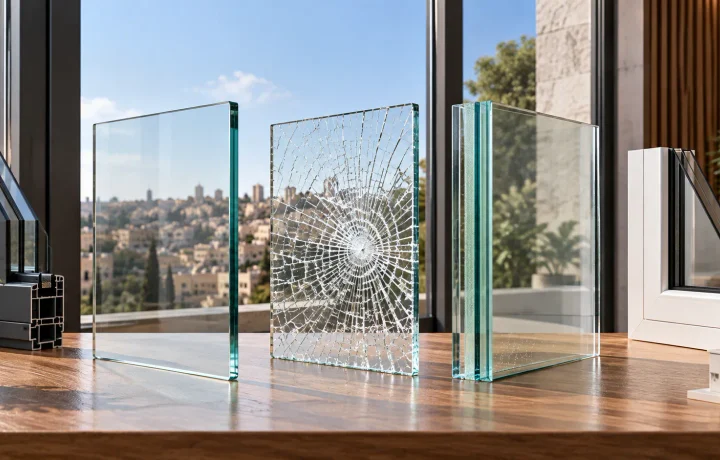
Laminated glass places an interlayer between glass plies. That interlayer adds damping, and acoustic PVB products are available specifically to improve sound attenuation.
Cardinal notes that laminated glass can reduce sound more efficiently than monolithic glass of the same nominal thickness, with performance depending on the interlayer and overall glass configuration. Cardinal Glass Industries
Do not translate that into “laminated is always the best window.” The full build-up still matters.
If you are choosing between safety glass options as well as sound control, the JoWindows guide to tempered vs laminated glass for windows explains why the two products behave differently.
Asymmetrical glass deserves attention
Two panes do not have to be identical.
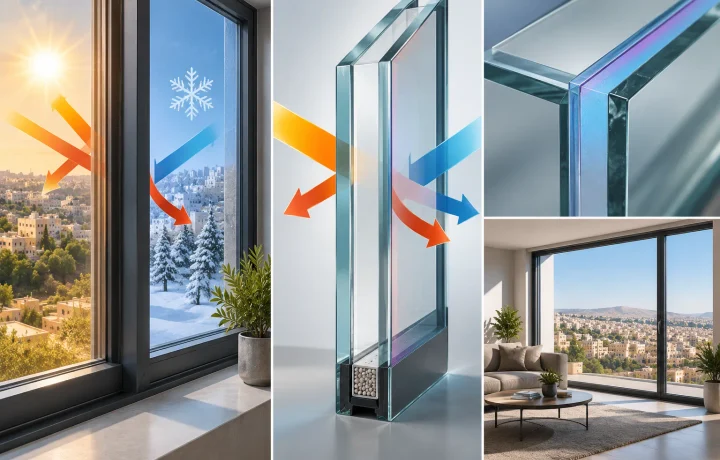
Changing pane thicknesses, cavity dimensions and laminated layers changes the way a glazing assembly responds across frequencies. Manufacturer acoustic tables show meaningful differences among assemblies that all fall under the broad labels “double glazing” or “laminated glass.” Viracon
That is why a quotation saying only “double glass” is inadequate if noise reduction is the reason you are buying the window.
Ask for the actual build-up.
For example:
glass thickness + spacer/cavity + second glass thickness + laminated interlayer, if any.
That description can be matched to test data. “Double-pane acoustic window” cannot.
Glass-only STC/OITC is not the same as a complete-window rating
This is one of the most important questions to ask a supplier.
Many acoustic charts describe the glass assembly rather than the complete operable window. The frame, sash, gaskets and construction of the finished unit also influence acoustic performance.
Cardinal explicitly notes that final window STC/OITC can differ from the base glass data because framing and window construction affect the result. Cardinal Glass Industries
So when two quotations appear to offer the same “OITC 35,” ask:
Was OITC 35 measured for the complete window or only for the glass build-up?
Those are not interchangeable claims.
Opening style can affect the result too
Acoustic glass installed in a weakly sealing operable frame is a poor use of money.
Different opening systems seal differently, and actual performance depends on the specific frame, hardware, gaskets and tested assembly. A casement-style sash that compresses against its seals behaves differently from a sliding sash moving along tracks.
That does not mean every casement window will outperform every slider. It means the opening system belongs in the specification, not just the glass.
If you are still choosing the operation type, compare casement vs sliding windows before finalizing the acoustic package.
What to ask for when comparing two window quotations
Do not ask only, “What is the STC?”
Ask the supplier for:
- The OITC rating if exterior traffic, aircraft or rail noise is the problem.
- The STC rating as a second reference where available.
- The exact tested configuration: glass build-up, frame and opening type.
- Whether the published number is glass-only or complete-window data.
- The test standard or laboratory report behind the rating.
- Frequency-band transmission-loss data if the project has a severe or unusual noise source.
- Confirmation that the window you are ordering matches the unit that produced the quoted rating.
A performance number attached to a different glass thickness, different sash or different specimen does not prove the window in your quotation performs the same way.
Is a higher OITC always better?
Within comparable products tested on the same basis, a higher OITC indicates greater attenuation under the OITC method.
But “higher” still does not tell you whether the upgrade is worth paying for in your room. The answer depends on the outside noise spectrum, wall construction, other façade openings and the difference between the competing window systems.
ASTM E1332 also excludes some unusual spectra and emphasizes the limitations of reducing frequency-dependent performance to one value. ASTM Store
For a normal road-noise comparison, OITC is a very useful sorting tool. For a bedroom under a flight path or beside heavy industrial equipment, acoustic design should go farther.
Should you buy the window with the highest STC?
Not for traffic noise just because the STC number is larger.
If two exterior windows are being considered for road, train or aircraft noise, first compare OITC-to-OITC for the exact assemblies. Then examine the construction behind the number.
A well-documented OITC result for the complete window is more useful than a spectacular STC figure copied from a glass chart that was never tested in the frame you are buying.
That is the specification habit that prevents the most expensive acoustic mistake: paying for an impressive number that answers the wrong noise question.