Tempering changes the strength and breakage behaviour of a glass pane. Laminating bonds two or more panes with an interlayer so the broken glass can remain held together.
Those are different functions.
More importantly, they can be combined. A laminated make-up can use tempered panes.
That single fact changes the comparison.
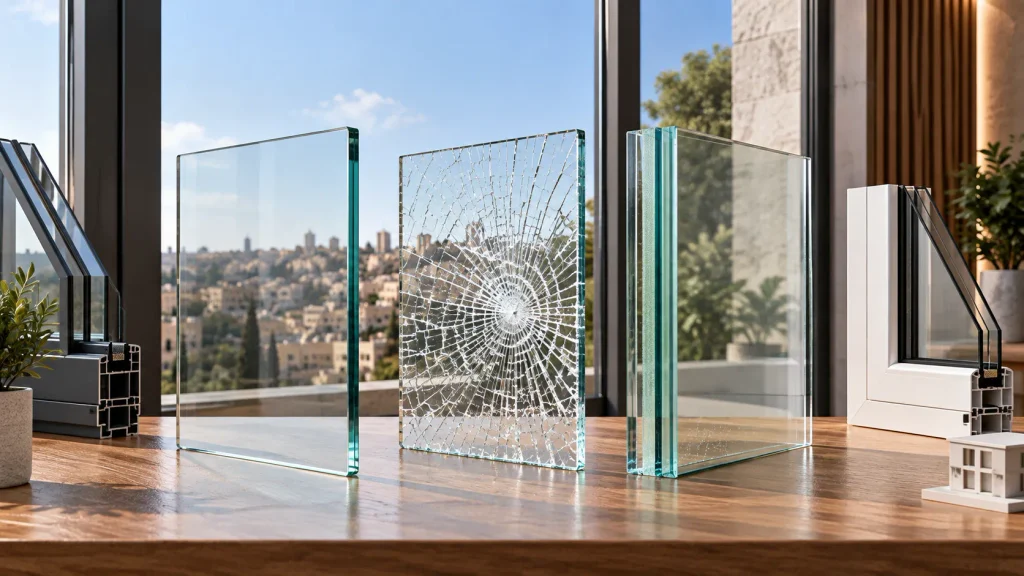
Tempered vs laminated glass at a glance
| Priority | Tempered glass | Laminated glass | Tempered laminated glass |
|---|---|---|---|
| Resistance to mechanical stress | Strong | Depends on pane make-up | Strong |
| Safer breakage pattern | Yes | Yes, by retaining fragments | Yes |
| Glass remains in opening after breakage | Limited | Much better | Much better |
| Forced-entry delay | Limited on its own | Can be designed for it | Can be designed for it |
| Acoustic options | Not its main benefit | Strong potential | Strong potential |
| UV screening | Not a tempering benefit | Depends on interlayer | Depends on interlayer |
| Can be used in IGUs | Yes | Yes | Yes |
The correct choice starts with the failure mode you are trying to manage.
A glass door where human impact is the main concern is not the same problem as a bedroom facing road traffic, or a ground-floor window where post-breakage security matters.
What tempered glass actually does
Tempered glass is heat treated.
The process creates a different stress pattern in the glass, increasing its mechanical resistance compared with ordinary annealed glass and changing the way it breaks.
When fully tempered glass fails, it is designed to fragment into many relatively small pieces rather than the large sharp shards associated with ordinary annealed glass.
That is why it is widely used for doors, partitions, shopfronts and other safety-sensitive applications.
There is also an important fabrication consequence: holes, notches, cut-outs and most edge work must be completed before tempering.
Once the panel has been tempered, you do not take it back to the workshop and casually cut a new hinge notch.
This is why hardware selection and accurate measurements matter so much in frameless glass work. JO Windows covers that process in more detail on our tempered glass doors and partitions service page. tempered glass doors and partitions
What laminated glass actually does
Laminated glass uses two or more panes bonded with an interlayer, commonly PVB.
If the glass cracks, the interlayer helps retain the fragments instead of allowing the entire pane to fall away immediately.
That post-breakage behaviour is the reason laminated glass appears in applications involving safety, security, overhead glazing, acoustic control and UV management.
But “laminated glass” does not describe one fixed strength.
A laminate made from two annealed panes with a standard interlayer is a different product from one using thicker heat-strengthened or fully tempered panes and a specialist security interlayer.
Always ask for the actual make-up.
Can laminated glass also be tempered?
Yes.
This is one of the most useful points to understand before asking for a quotation.
The individual plies used to create laminated glass can be annealed, heat strengthened or tempered, depending on the required design.
So the choice is not always:
Tempered OR laminated.
A project may call for tempered laminated glass where both higher pane strength and post-breakage retention are useful.
That does not mean tempered laminated is automatically the best specification for every window. It normally costs more and still needs to be matched to the frame, support and application.
Use performance requirements to select the build-up — not the longest list of glass treatments.
Which is safer when the glass breaks?
They address safety differently.
Tempered glass is designed to break into a safer fragmentation pattern.
Laminated glass is designed so that the interlayer can hold broken fragments together.
For a shower screen or frameless internal door, the way tempered glass fragments may be the main requirement.
For a window above a drop, an overhead panel or another location where pieces falling out of the opening create a second hazard, retention after breakage can become more important.
There is no useful “winner” without knowing the application.
Which is better for security?
If by security you mean resistance after someone deliberately breaks the glass, laminated glass provides a much more useful design path.
Ordinary tempered glass can be mechanically strong, but once it breaks it typically loses the barrier formed by the pane.
A properly designed laminated make-up can remain held together and continue creating a physical obstacle after breakage.
But do not turn that into the phrase “laminated glass is burglar-proof.”
Security performance depends on far more than the glass label:
the number and thickness of panes, interlayer type and thickness, the glazing bite, frame stiffness, fixings and the way the glass is retained in the frame all matter.
A strong pane installed in a weak frame is not a strong window.
For security-sensitive openings, ask for a tested or engineered assembly, not a vague promise about one component.
Is laminated glass better for noise?
Often, yes — if the glazing is designed for acoustics.
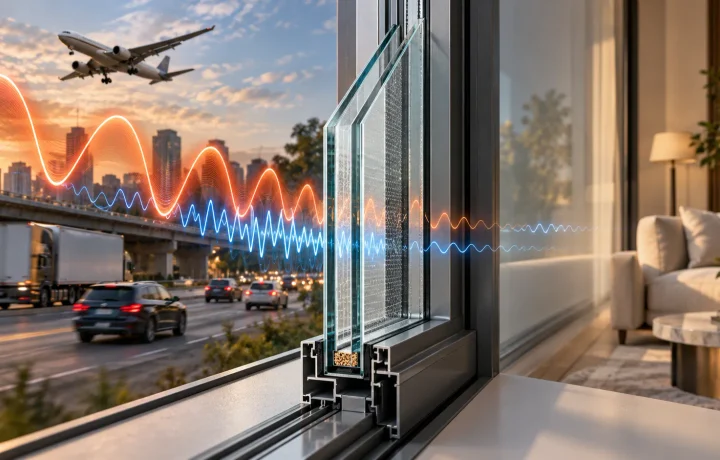
The PVB interlayer in laminated glass adds damping, and specialist acoustic interlayers are available for higher performance.
But simply changing a 6 mm pane to “some laminated glass” does not guarantee a quiet bedroom.
Sound performance depends on the full glazing build-up.
Pane thicknesses, asymmetry between panes, the interlayer, airspace inside an insulating glass unit, frame type, gaskets, locking pressure and gaps around the installation all influence the result.
That is particularly important for traffic and aircraft noise because different frequency ranges behave differently.
Specialist products such as acoustic laminated glass can be combined with an insulating glass unit to address both noise and thermal requirements.
Can I replace only the glass to reduce road noise?
Sometimes. Not always.
If the existing frame closes tightly, uses effective seals, supports a suitable glass thickness and has enough glazing pocket depth, replacing only the glass may improve performance.
If the window itself leaks air around sliding tracks, damaged gaskets or poorly sealed perimeter joints, a premium acoustic pane can disappoint.
Sound uses gaps.
A narrow air leak can undermine a much more expensive glazing upgrade.
Before replacing glass alone, check whether the existing frame can physically take the required make-up and whether the sash, hardware and seals are still doing their job.
Our complete window system for noise reduction approach on the uPVC windows page explains why glass, frame, gaskets, hardware and installation have to be considered together. complete window system for noise reduction
Does laminated glass block UV?
The interlayer can provide substantial UV screening, but the exact figure depends on the interlayer product and the wavelength range being quoted.
This is an area where marketing numbers are easy to oversimplify.
Some conventional architectural PVB products screen approximately 99% of UV up to a specified wavelength, while specialist UV interlayers extend performance farther into the spectrum.
So do not write “laminated glass blocks 99% of all UV” into a project specification and assume the problem is solved.
Ask which interlayer is being supplied.
UV control is useful for interiors with fabrics, flooring, artwork or furnishings exposed to direct sun, but fading is also affected by visible light, heat and material sensitivity.
Glass is one part of the protection strategy.
Is tempered glass better for heat insulation?
Tempering itself is not a thermal-insulation upgrade.
A pane does not suddenly achieve a low U-value because it was tempered.
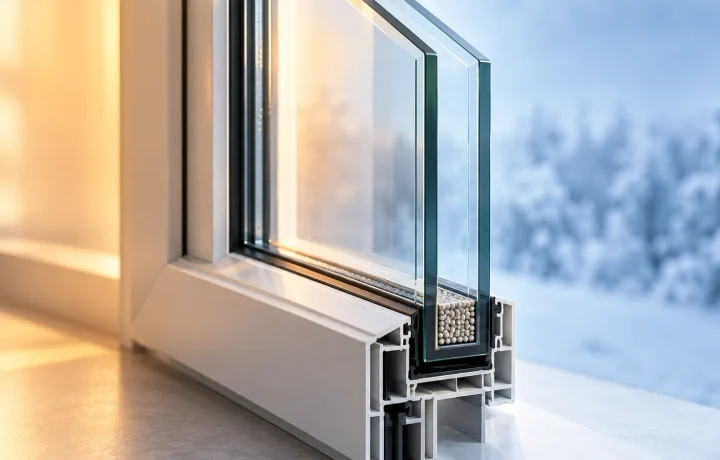
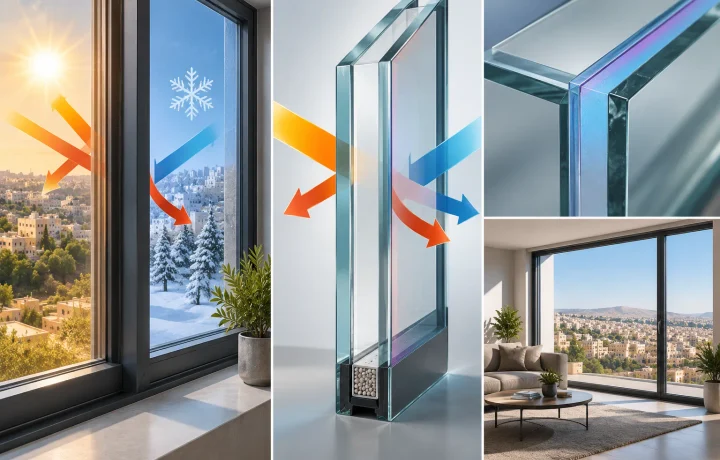
Thermal performance usually comes from the complete glazing system: insulated glass units, cavity width, gas fill where specified, Low-E coatings, warm-edge details, frame conductivity, seals and installation.
The same applies to laminated glass.
Lamination can provide safety, security, acoustic or UV functions depending on the make-up, but it does not replace a properly designed IGU when heat transfer is the main concern.
A window can therefore use laminated glass as one pane of a double-glazed unit and combine it with Low-E glass to achieve several objectives at the same time.
What should I use for a noisy bedroom?
Start by identifying the noise.
Steady road noise, horns, motorcycles and aircraft do not behave exactly the same.
Then inspect the existing window for air leakage.
If the window is otherwise suitable, an acoustic laminated pane or asymmetric IGU may help substantially. If the sash rattles or there are open brush gaps, improve the window system itself.
In Jordan, that can mean comparing uPVC and aluminium systems by how the specific series closes and seals rather than assuming one material is automatically quiet.
For aluminium projects, the glass specification for aluminium windows should be reviewed together with the profile, opening type and seals. glass specification for aluminium windows
What should I use for a ground-floor window?
If accidental impact is the only concern, safety glazing selected for the location may be enough.
If forced-entry delay is also a priority, laminated glass becomes more relevant because of its behaviour after breakage.
But specify the complete window.
Ask how the laminate is retained, how deep the glazing bite is, what frame and hardware are being used and whether the proposed assembly has an appropriate security classification or test where required.
Security glass in a weak sliding frame does not create a secure opening by itself.
What about balcony doors and large panes?
Large panes introduce more than one issue at the same time.
Human impact, wind loading, panel dimensions, support, edge condition and thermal stress can all affect the specification.
This is where generic advice such as “use 10 mm tempered” becomes risky.
Panel size matters.
Support condition matters.
Whether the pane sits inside an aluminium sash, acts as a frameless door or forms part of a fixed façade matters.
Glass thickness should follow the actual opening and required performance, not a rule copied from another project.
Tempered vs laminated for shopfronts
A shopfront may prioritise appearance and large clear panels, but security after closing hours can alter the glass decision.
Tempered glass is widely used in commercial fronts and doors because of its strength and breakage characteristics.
Where post-breakage retention and forced-entry delay matter more, laminated or tempered-laminated configurations may be considered.
Hardware and support details still govern the finished result.
A frameless door has a completely different load path from a laminated pane captured continuously inside a robust frame.
What should a glass quotation actually say?
“Double glass” is not enough.
“Laminated” is not enough.
“Tempered” is not enough.
A useful quotation should identify the actual make-up.
For example, it should clarify pane thicknesses, which panes are tempered or heat strengthened, whether an interlayer is standard, acoustic or security-oriented, the spacer gap if part of an IGU, Low-E coating where applicable, frame system, gaskets, hardware and installation scope.
Two windows can both be described as “double glazed laminated” and still perform very differently.
Quick selection guide
| Your main priority | Start the discussion with |
|---|---|
| Human impact safety | Safety-treated glass appropriate to the location |
| Glass staying together after breakage | Laminated glass |
| Forced-entry delay | Security laminated make-up + suitable frame |
| Road or aircraft noise | Acoustic glazing + sealed window system |
| UV-sensitive interiors | Specified UV-screening interlayer |
| Thermal insulation | IGU/Low-E/frame specification |
| Frameless doors or partitions | Tempered glass or engineered laminated option depending on design |
| Several priorities together | Multi-functional laminated/tempered/IGU build-up |
The best glass specification rarely comes from picking the product with the most impressive name.
Start with what must happen before and after breakage, how much noise or heat you need to control, and what frame will hold the glass.
Once those questions are clear, tempered and laminated stop being competing labels and become design tools.