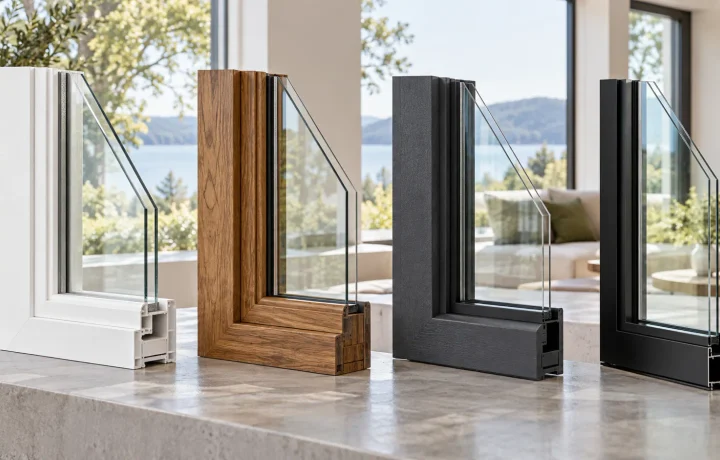
Vinyl usually wins on upfront price, availability, and low maintenance. Fiberglass is stiffer, more dimensionally stable, paintable in many product lines, and commonly sold as the more premium frame material. The catch is price: fiberglass can cost considerably more.
Energy efficiency is where the comparison is often oversimplified. A fiberglass frame does not automatically make a better-performing window. The glass package, Low-E coating, gas fill, spacers, air leakage, opening style, and installation can matter as much as — and sometimes more than — the frame material itself. The U.S. Department of Energy recommends comparing the performance of the complete window rather than choosing by frame label alone.
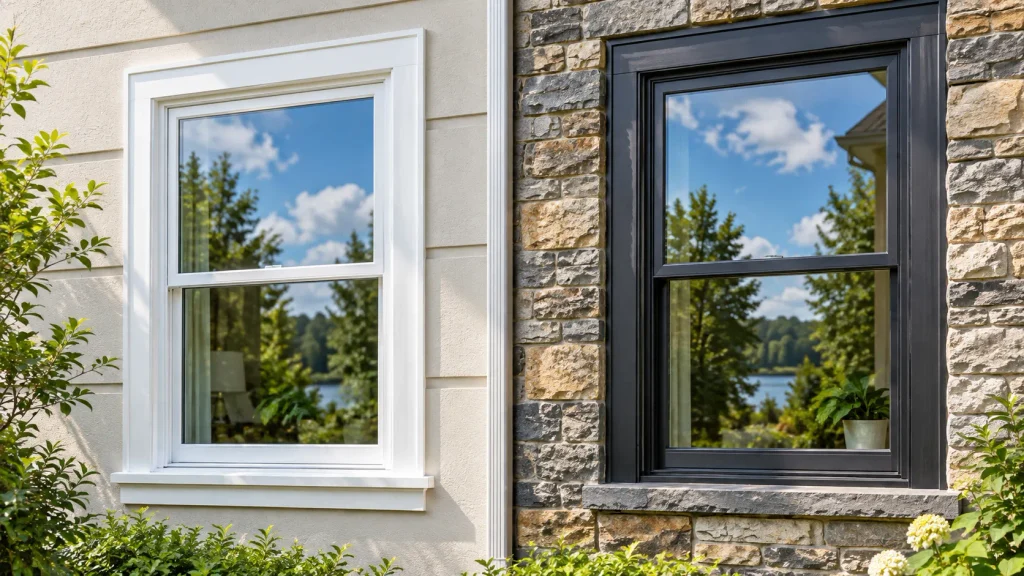
Vinyl vs Fiberglass Windows at a Glance
| Factor | Vinyl Windows | Fiberglass Windows |
|---|---|---|
| Upfront cost | Usually lower | Usually higher |
| Maintenance | Very low | Low; some finishes can be repainted |
| Dimensional stability | Good, but PVC expands and contracts more | Excellent |
| Frame rigidity | Good; varies widely by profile and reinforcement | Generally higher |
| Color flexibility | Depends on product line | Often broader; many are paintable |
| Moisture resistance | Very good | Very good |
| Typical market lifespan estimate | Around 20–40 years | Around 30–50 years |
| Thermal performance | Can be excellent in a well-designed window | Can be excellent, especially with insulated cavities |
| Availability | Very broad in many markets | More limited in some markets |
| Best fit | Value, low maintenance, broad product choice | Long-term ownership, rigidity, finish flexibility, premium specifications |
The lifespan figures above are market estimates, not warranties. Actual service life depends on climate, product quality, exposure, hardware, glazing, installation, and maintenance.
How Much Do Vinyl and Fiberglass Windows Cost?
This is the clearest difference between the two.
HomeGuide’s 2026 U.S. estimates put installed vinyl windows at roughly $250–$750 per window, while fiberglass windows are around $500–$1,500 per window. Within those ranges, budget and premium products overlap: premium vinyl is listed around $450–$750 installed, while budget fiberglass runs around $500–$900.
Those are U.S. estimates, not universal pricing. Labor, import costs, taxes, window size, operating style, glazing specification, removal work, trim, access, and local manufacturing can change the price dramatically in another country.
There is a more useful lesson hidden in the numbers: do not compare a premium vinyl window with a basic fiberglass window on frame material alone. A higher-priced material does not guarantee the better complete window.
If the fiberglass upgrade consumes enough of the budget that you have to downgrade the glass package, hardware, or installation, reconsider the comparison.
Is Fiberglass Better Than Vinyl Windows?
In a few areas, fiberglass has a genuine material advantage.
The Department of Energy describes fiberglass frames as dimensionally stable and notes that their cavities can be insulated. Vinyl frames are made from PVC, resist moisture, require no painting, and can also have insulated cavities.
The practical difference appears when temperatures change and window sizes increase. A stiffer, more dimensionally stable frame is easier to value in a large opening, a dark exterior finish exposed to strong sun, or a project expected to stay in service for decades.
That still does not make fiberglass the automatic choice for an ordinary replacement window. Good vinyl systems can deliver strong air sealing, low U-factors, reinforced profiles, durable welded construction, and excellent glazing packages at a lower price.
The useful comparison is not:
fiberglass vs vinyl
It is:
this fiberglass window vs this vinyl window, in the same size, with comparable glass, hardware, opening style, installation, and warranty.
Which Is More Energy Efficient?
Start with the rating, not the frame label.
NFRC defines U-factor as a measure of heat transfer through the product: lower is better for resisting heat flow. SHGC, or Solar Heat Gain Coefficient, describes how much solar heat passes through the window. Air Leakage measures air entering through the product.
A fiberglass frame can provide strong thermal performance because of its stability and the possibility of insulating its cavities. Insulated vinyl frames can also perform very well. DOE specifically points out that glazing is one of the most important energy-efficiency decisions in a window.
That is why two vinyl windows can have very different U-factors, and two fiberglass windows can too.
For a real quote, ask for:
- whole-window U-factor rather than center-of-glass performance;
- SHGC appropriate to the climate and orientation;
- Low-E coating specification;
- double- or triple-pane construction;
- gas fill where used;
- spacer system;
- air-leakage data where available;
- exact opening style.
If you are still deciding how much glass performance you actually need, the JO Windows guide to double-pane vs triple-pane windows separates the pane-count question from the frame-material decision. double-pane vs triple-pane windows
The separate guide to Low-E glass and U-factor is also worth reading before paying more for a frame while leaving the glazing specification vague.
Does Fiberglass Last Longer Than Vinyl?
Fiberglass is commonly given the longer expected service life.
HomeGuide uses typical estimates of around 20–40 years for vinyl and 30–50 years for fiberglass. Angi uses a narrower 20–30-year estimate for vinyl and 30–50 years for fiberglass. These figures are useful for planning, but they should not be treated as expiration dates.
A window can fail for reasons unrelated to the basic frame material.
The insulated glass unit can lose its seal. Hardware can wear out. Weatherstripping can deteriorate. Drainage can be blocked. Poor installation can allow air or water leakage around an otherwise healthy frame.
That distinction matters because a failed glass seal does not always justify replacing the entire window. JO Windows covers the repair decision separately in its guide to foggy double-pane windows.
Which Handles Heat and Temperature Changes Better?
Fiberglass has the clearer advantage in dimensional stability.
PVC is a good window-frame material, but it moves more as temperature changes. Well-designed vinyl systems account for that movement through profile geometry, reinforcement, manufacturing tolerances, glazing, and installation.
This becomes more relevant with very large frames, strong sun exposure, dark colors, and significant temperature swings. It matters much less to a buyer choosing between two modestly sized windows that have both been correctly engineered for their intended conditions.
Do not reduce this question to “Does vinyl warp?”
Poorly specified or poorly manufactured vinyl can distort. That does not mean distortion is the normal outcome for every vinyl window. Product design matters.
Maintenance: Which Is Easier to Own?
Vinyl is difficult to beat for routine simplicity.
It does not need periodic painting, resists moisture, and its finished color is normally part of the manufactured profile or surface system. DOE specifically identifies moisture resistance and lack of painting as vinyl advantages.
Fiberglass is also a low-maintenance material, but some fiberglass window finishes are selected partly because they can be painted or refinished. That is an advantage if you value color flexibility. It is extra maintenance if your goal is to never think about the finish again.
Neither frame is maintenance-free in the literal sense. Tracks, drainage paths, gaskets, locks, hinges, operators, weatherstripping, and perimeter seals still need occasional inspection.
What Are the Negatives of Fiberglass Windows?
Price comes first. For comparable sizes and styles, fiberglass often costs substantially more.
Availability is another issue. Vinyl has a very broad replacement-window market in many countries, whereas fiberglass can offer fewer manufacturers, fewer installers, or longer lead times depending on the region.
Some fiberglass systems are paintable, which is excellent for design flexibility but removes part of the “never repaint it” simplicity associated with vinyl.
Installation deserves attention too. Paying for a strong frame does not compensate for an opening that was measured poorly, flashed incorrectly, fastened badly, or sealed carelessly.
The extra money makes sense only if you are buying advantages you will actually use.
Why Aren’t Fiberglass Windows as Common as Vinyl?
Cost explains much of it.
Vinyl became a mainstream replacement-window material because it combines low maintenance, moisture resistance, manufacturability, and competitive pricing. Fiberglass occupies a more premium part of the market and is not offered by as many manufacturers in every region. HomeGuide also identifies broader vinyl availability and a higher fiberglass purchase price as practical differences.
That should not be interpreted as a quality vote.
A material can be technically strong and still hold a smaller market share because it costs more to buy or is harder to source.
Are Fiberglass Windows Worth the Money?
They can be.
Fiberglass becomes easier to justify when the project has large openings, demanding exposure, a long ownership horizon, a preference for paintable finishes, or a specification where frame rigidity and dimensional stability are valuable.
Vinyl becomes harder to dismiss when the price difference is substantial and the competing vinyl product already provides the U-factor, SHGC, air sealing, hardware quality, glazing, and warranty you need.
For many buyers, the right question is not whether fiberglass is “worth it” in the abstract.
Ask what the fiberglass upgrade buys on the actual quotation.
If it buys a stronger frame, slimmer profile, better finish, longer warranty, better tested performance, or some other measurable improvement you value, the premium has a reason behind it. If the quote simply replaces the word “vinyl” with “fiberglass” and leaves the rest of the specification vague, you still do not know what you are paying for.
Which Is Better for Noise: Vinyl or Fiberglass?
Do not choose the frame material first if noise is the main problem.
Exterior noise control depends heavily on the complete window: glass thickness, laminated glass, cavity design, sash seals, air leakage, frame construction, opening style, and installation.
A tightly sealed operable window with the right acoustic glazing can outperform a more expensive frame paired with ordinary glass and weak sealing.
For road, aircraft, or neighborhood noise, start with the glass specification. The JO Windows guide to laminated glass for noise reduction explains why laminated construction and the complete glazing build-up deserve more attention than a simple frame-material comparison.
Opening style matters as well. A hinged sash that compresses against seals behaves differently from a slider that moves along tracks and meeting rails. The comparison between casement vs sliding windows is therefore worth making separately from the vinyl-versus-fiberglass decision.
Premium Vinyl vs Budget Fiberglass
This is where material-only comparisons break down.
Suppose one quote offers premium vinyl with Low-E insulated glass, good hardware, reinforced profiles, published whole-window performance, and careful installation. Another offers entry-level fiberglass with a less capable glass package and a vague installation scope.
The word “fiberglass” does not rescue the second quote.
Compare the complete specifications line by line.
A useful quotation should identify the frame series, exact glazing build-up, Low-E option, gas fill if applicable, opening type, glass safety treatment where required, hardware, finish, installation method, removal and disposal work, interior/exterior finishing, and warranties.
If one contractor will not tell you what is actually being supplied, the comparison is not finished.
Fiberglass vs Vinyl vs Aluminum
Aluminum deserves a separate comparison because it behaves differently.
It is strong, light, and well suited to slim frames and large glazed areas, but conventional aluminum conducts heat readily. DOE notes that high-performance aluminum systems use a thermal break to reduce heat flow through the frame.
So “vinyl vs fiberglass vs aluminum” is not a three-column contest with one universal winner.
A thermally broken aluminum system designed for large architectural openings is solving a different problem from an economical vinyl replacement window. Compare the application first.
What Should You Compare Before Ordering?
The last decision should be made from the actual window schedule or quotation, not from a generic pros-and-cons list.
Put the competing products side by side and check the frame series, opening style, reinforcement, glazing, U-factor, SHGC, air leakage, glass safety requirements, hardware, finish, drainage, installation scope, and warranty.
Then look at the price difference.
If the fiberglass option materially improves what your project needs, it may justify the premium. If the vinyl window already meets the required performance and the fiberglass quote is substantially higher, spending the difference on better glass or installation may deliver more value.
Compare the exact windows. The frame material is only one line of the specification.