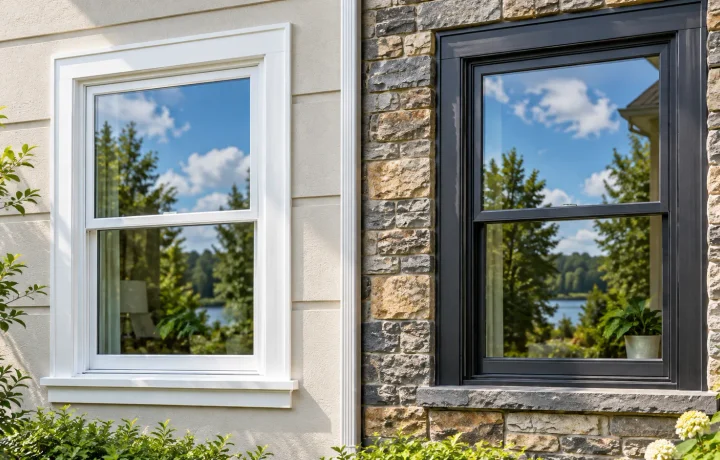
That distinction matters because the usual comparison is too crude: vinyl is called efficient, aluminum inefficient, wood beautiful, and fiberglass premium. Real products do not line up that neatly.
A thermally broken aluminum window with well-specified glazing can outperform a poorly configured window made from a material with lower conductivity. A bargain vinyl frame and a reinforced multi-chamber vinyl system are not equivalent products. Wood with exterior cladding behaves differently from exposed wood. Fiberglass strength does not make every fiberglass window suitable for every oversized opening.
Start with the frame material. Finish with the complete window.
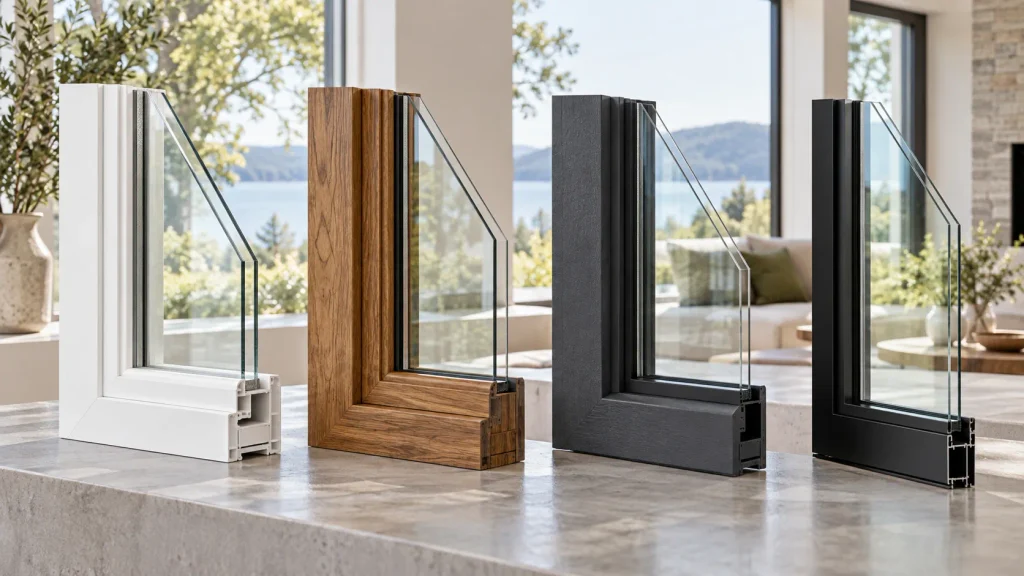
The four materials at a glance
| Priority | Vinyl | Wood | Fiberglass | Aluminum |
|---|---|---|---|---|
| Low routine maintenance | Strong fit | More maintenance unless clad | Strong fit | Strong fit with suitable finish |
| Thermal performance | Often good | Naturally favorable | Often very good | Highly dependent on thermal break |
| Narrow sightlines | Product-dependent | Usually not its main advantage | Product-dependent | Often a major advantage |
| Large glazed openings | Depends heavily on reinforcement and system | Product-dependent | Strong material, but size limits still matter | Often well suited to large spans |
| Interior finish flexibility | Limited by product | Excellent for paint/stain | Depends on factory system | Usually factory-finished |
| Moisture/rot concern | Does not rot like wood | Needs protection from sustained moisture | No wood rot | Does not rot; finish/corrosion exposure still matters |
| Upfront budget tendency | Often competitive | Commonly higher | Commonly higher | Varies widely by system |
That table is a starting point, not a specification.
Stop comparing frame conductivity as if it were the window U-Factor
Aluminum conducts heat readily. The U.S. Department of Energy therefore recommends a thermal break between the indoor and outdoor portions of a metal frame to reduce heat flow. Vinyl, wood and fiberglass generally provide greater inherent thermal resistance.
But the number a buyer should compare is the whole-window U-Factor, not the conductivity of a raw strip of frame material.
NFRC ratings account for the window as an assembly, and NFRC even classifies non-thermally-broken aluminum separately from aluminum with thermal breaks or other thermal improvements.
Current NFRC-certified examples show why the distinction matters. Thermally broken aluminum products can be found with whole-window U-Factors around 0.29–0.30 in particular configurations, while non-thermally-broken aluminum examples can be substantially higher. Those examples do not prove that every thermally broken aluminum window beats every vinyl or wood window; they prove that “aluminum” is far too broad a specification.
When reviewing a quote, ask for U-Factor and SHGC for the exact configuration. The Low-E glass guide explains why the glass package, coating, gas fill and frame must be considered together.
Vinyl: practical, low maintenance, but quality matters more than the label
Vinyl frames are typically made from PVC. They do not need routine painting, handle moisture well, and can use hollow chambers or insulated cavities to improve thermal performance. The Department of Energy identifies vinyl as a material with good moisture resistance and useful insulating potential.
This makes vinyl particularly attractive for standard residential replacement projects where cost, efficiency and low maintenance matter more than very narrow frame profiles or custom interior finishing.
The mistake is assuming all vinyl frames are interchangeable.
Profile design, wall thickness, chamber layout, reinforcement, welded corners, dark exterior finishes, sash size and hardware all affect the finished window. Large openings deserve particular attention because reinforcement and product-specific size limits start to matter more as dimensions increase.
If your project involves unusually large units, do not approve the material first and figure out structural limits later. Ask for the tested size and configuration.
Where vinyl usually makes sense
For conventional residential openings, a well-made vinyl window is often an efficient route to low maintenance without moving into the higher price bands commonly associated with wood or fiberglass.
It is less compelling when the architectural brief demands extremely slim sightlines, extensive stain or paint customization, or very large moving panels that are better served by another engineered system.
Wood: still difficult to replace when the interior finish matters
Wood earns its place for reasons that have little to do with nostalgia.
It insulates relatively well and can be painted or stained to suit an interior in a way factory-colored vinyl usually cannot. The Department of Energy also notes the tradeoff: wood requires maintenance, while exterior aluminum or vinyl cladding can reduce that maintenance burden.
That makes clad wood important in this comparison. A wood window with protected exterior cladding is not the same maintenance proposition as bare exterior timber.
Manufacturers offer unfinished or primed wood interiors specifically so they can be stained or painted, while aluminum exterior cladding protects the weather-facing side.
For traditional architecture, restoration work, high-end interiors and rooms where the frame is intended to look like finished joinery rather than a neutral perimeter around glass, wood still has a genuine advantage.
Its weakness appears when maintenance is ignored.
Repeated moisture exposure, damaged finishes and neglected exterior protection create conditions in which wood can deteriorate. A good wood frame can have a very long service life when it is well made, protected and maintained; the material simply asks more of the owner than vinyl or fiberglass.
Fiberglass: dimensional stability is the useful feature
Fiberglass often gets sold through the word “strength.” Stability is at least as important.
The Department of Energy describes fiberglass frames as dimensionally stable and notes that their cavities can be insulated. That combination makes the material useful where thermal performance and resistance to dimensional movement are priorities.
It can also suit larger or more demanding configurations, although maximum size still comes from the tested window system, mullion design and structural requirements—not from the word fiberglass on a brochure.
Expect the purchase price to be less budget-oriented than basic vinyl in many markets. Availability is also more uneven because vinyl, aluminum and wood product lines are offered by a broader range of manufacturers in many regions.
Fiberglass is therefore most interesting when you are prepared to pay more upfront for a stable, low-maintenance frame and the exact product has the glass, hardware and ratings you need.
Aluminum: separate old assumptions from modern systems
Unbroken aluminum is thermally conductive. That fact has not changed.
What has changed is the range of systems available.
Modern thermally improved or thermally broken aluminum windows insert a less-conductive barrier between interior and exterior aluminum sections to reduce direct heat flow. This does not turn every aluminum frame into a high-performance window, but it changes the comparison enough that dismissing aluminum solely because it is metal is poor buying practice.
Aluminum’s structural stiffness also allows manufacturers to create products with narrow sightlines and large glazed areas. Current commercial products demonstrate thermally broken aluminum window-wall systems with narrow profiles and very large tested sizes. The allowable dimensions for your project still need to come from that product’s engineering and performance data.
That makes aluminum particularly relevant to modern architecture, wide picture windows, window walls and projects where minimizing visible frame is part of the design brief.
What about condensation?
Do not answer this from material alone.
An unbroken metal frame can create colder interior surfaces in winter, increasing condensation risk under the same indoor humidity conditions. A thermally improved frame can reduce that effect, while glazing, spacers, indoor humidity and outside temperature all matter too.
If moisture is already a concern, first identify whether you have room-side condensation, exterior dew or moisture trapped between panes. The window condensation guide separates those three problems.
Coastal exposure changes the aluminum question
“Aluminum does not rot” is true but incomplete.
Coastal projects still need attention to coating quality, exposed fasteners, hardware, drainage and maintenance. Architectural coating standards such as AAMA 2605 include performance testing for properties including weatherability and corrosion resistance.
So the useful question for a coastal aluminum quote is not merely:
“Is the frame powder coated?”
Ask what finish system and performance specification apply to the actual product, and whether the hardware and fasteners are suited to the exposure.
Salt exposure can punish weak details even when the frame material itself is fundamentally durable.
What changes in hot, cold and mixed climates?
In a hot sunny climate, reducing unwanted solar gain can be more important than chasing a frame-material label. SHGC, Low-E coating selection, shading and orientation become major parts of the decision.
In a heating-dominated climate, a lower whole-window U-Factor and warmer interior surfaces carry more weight.
ENERGY STAR’s current U.S. window criteria reflect exactly this climate dependence: the required U-Factor and SHGC change by climate zone rather than treating one specification as ideal everywhere.
The same logic applies even outside the U.S. climate-zone system. Specify for the climate the building actually experiences.
And if you are still deciding how many panes you need, compare double-pane vs triple-pane windows separately. Frame material and pane count answer different questions.
Does frame material determine sound performance?
No.
A heavy-looking frame is not automatically a quiet window, and a fiberglass frame is not automatically more acoustic than vinyl or aluminum.
Glass thickness, laminated layers, spacing between panes, seals, opening style, frame construction and installation all contribute. For traffic or aircraft noise, the actual acoustic test data matters much more than a generic material claim.
JoWindows’ guide to STC vs OITC window ratings explains why transportation noise should not be judged from an STC number copied from an unrelated glass chart.
Opening style can change the answer again
A frame material comparison assumes you are comparing similar window configurations. In practice, a casement, slider, fixed picture window and large lift-slide system place very different demands on profiles, hardware and seals.
If you have not chosen the operation type yet, make that decision alongside the frame—not afterward. The comparison of casement vs sliding windows covers the ventilation, sealing and practical differences.
A narrow aluminum picture frame and an operable aluminum slider are not the same performance problem.
How much does each frame material cost?
There is no useful global price table. Labor, product positioning, import costs, window style and glass specification can overwhelm the material difference.
One current U.S. data point is useful only as context. In a 2026 survey of 1,000 homeowners, This Old House reported average window costs of about $453 for aluminum, $472 for vinyl, $544 for wood and $564 for fiberglass. The publication notes that window type, glass package, installation complexity and project scope can materially change the price.
Do not turn that ordering into a rule for another country—or even another product line in the same U.S. market.
A thermally broken architectural aluminum window wall is not competing with a basic aluminum replacement window simply because both are aluminum.
Which material lasts longest?
Material-only lifespan tables look precise and usually are not.
A window can reach replacement because its insulated glass seals fail, hardware becomes obsolete, weatherstripping deteriorates, the sash distorts, the frame is damaged, the installation leaks or the owner wants a different performance level. The frame itself is only one component.
A more useful way to think about service life is to ask what each material demands:
Wood can last a very long time when protected, but neglected moisture and failed finishes are serious enemies.
Vinyl removes painting and rot from the maintenance list, but quality of profiles, reinforcement, hardware and exposure still matters.
Fiberglass offers strong dimensional stability with relatively little routine frame maintenance.
Aluminum avoids wood rot and can remain structurally robust, while thermal design, finish durability, drainage and corrosion exposure require attention.
The window that survives longest is usually the well-specified, well-drained and correctly installed system whose maintenance requirements the owner is actually willing to meet.
A better way to choose
For a normal residential replacement where budget and low maintenance dominate, start by comparing well-built vinyl products against the other options on whole-window ratings.
For a traditional house where the interior frame is part of the architecture, wood or clad wood deserves serious consideration.
For buyers prioritizing dimensional stability and low maintenance and who can absorb a higher initial cost, fiberglass is a logical category to investigate.
For large openings, narrow sightlines or strongly contemporary architecture, thermally broken aluminum deserves comparison rather than automatic rejection.
Then forget the material names for a moment and put the actual quotations side by side:
whole-window U-Factor, SHGC, air leakage, structural/water rating where relevant, glass build-up, frame system, opening type, finish, hardware, drainage details, warranty and installation scope.
That comparison tells you far more than four samples of frame material sitting on a showroom desk.