But it should not be treated as a magic component that can make an otherwise average window highly efficient.
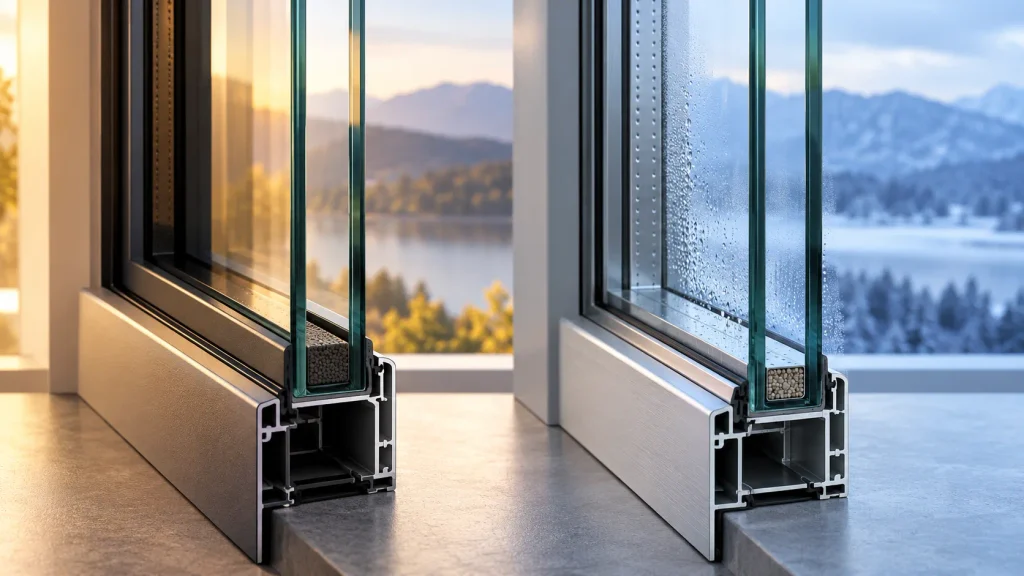
The spacer sits around the perimeter of an insulated glass unit, separating the panes and forming part of the edge-seal system. Because this edge is a thermal weak point in many IGUs, the spacer material and design can affect heat transfer, interior glass-edge temperature, condensation risk and whole-window performance.
That is why two windows with the same pane count, similar Low-E glass and the same gas fill can still perform differently around the edge of the glazing.
The useful comparison is not simply:
Warm edge = good, aluminum = bad.
It is:
How does the complete spacer and edge-seal system affect the finished window?
What Is the Spacer Bar in Double Glazing?
A typical double-glazed insulated glass unit, or IGU, contains:
- An outer pane of glass
- An inner pane of glass
- A sealed cavity between the panes
- A spacer around the perimeter
- Desiccant within or associated with the spacer system
- Primary and/or secondary edge seals
- Air or an insulating gas such as argon in many configurations
The spacer keeps the panes separated at the required distance.
Its surrounding edge-seal system also has to help control moisture and gas movement while accommodating the dimensional changes that occur as the unit heats, cools and experiences pressure changes.
So the spacer is not merely a strip used to keep two panes apart.
It forms part of one of the most critical areas of the IGU.
Why Does the Edge of Double Glazing Get Colder?
Consider a conventional double-glazed unit with efficient Low-E glass and an insulating gas cavity.
The center area of the glass may perform very well because heat has to pass through the glass layers, coating and insulated cavity.
At the perimeter, however, the glazing layers are connected through the spacer and edge-seal system.
A highly conductive spacer can create a stronger thermal bridge around this perimeter.
Traditional aluminum is particularly conductive.
In cold weather, that can make the room-side edge of the glass colder than the center of the pane.
The effect matters for two reasons:
- More heat can pass through the glazing edge.
- A colder interior surface is more likely to reach the dew point and develop condensation.
This does not mean that every wet glass edge is caused by an aluminum spacer. Indoor humidity, outdoor temperature, frame design, air leakage and installation all matter.
But spacer design is one of the variables.
Our guide to window condensation inside, outside and between the panes explains how to identify where the moisture is actually forming before blaming the IGU.
What Is a Warm Edge Spacer?
“Warm edge” describes a thermally improved spacer system rather than one single material.
Manufacturers may use different approaches, including:
- Thin metallic designs
- Stainless-steel-based systems
- Hybrid metal/polymer systems
- Flexible foam systems
- Thermoplastic or other low-conductivity edge technologies
Their designs differ considerably.
The common objective is to reduce heat transfer through the edge of the insulated glass compared with a conventional highly conductive aluminum spacer.
That means you should not assume that every product carrying the words “warm edge” performs identically.
Ask which spacer system is actually being supplied.
Warm Edge Spacer vs Aluminum Spacer
| Factor | Conventional Aluminum Spacer | Warm Edge Spacer System |
|---|---|---|
| Edge thermal conductivity | Relatively high | Designed to reduce edge heat transfer |
| Interior edge temperature in cold weather | Typically colder | Typically warmer |
| Condensation risk at glass edge | Generally higher under the same conditions | Generally lower |
| Effect on whole-window U-factor | Less favorable | Can improve whole-window performance |
| Materials | Aluminum | Varies by system |
| Gas and moisture sealing | Depends on complete edge-seal design | Also depends on complete edge-seal design |
| Cost | Often lower | May cost more |
| Performance consistency | Depends on exact system | Depends on exact product and fabrication quality |
The final two rows are important.
A warm-edge label alone does not prove good gas retention or long-term IGU durability.
Those properties depend on the complete spacer, desiccant, sealants, fabrication process and unit design.
Does a Warm Edge Spacer Really Improve U-Factor?
It can.
The effect occurs mainly around the perimeter of the glazing rather than at the center of the glass.
This is why a center-of-glass U-value does not tell the complete story.
A whole-window rating includes the effect of:
- Center-of-glass performance
- Glass-edge performance
- Spacer
- Frame
- Sash
- Other window components
If you are comparing two quotations, ask whether the stated U-factor or U-value refers to the entire window or only to the glass.
That distinction can matter more than the marketing name of the spacer.
For a deeper explanation of the other glazing variables, see Low-E Glass Explained: U-Factor, SHGC & Coating Surfaces.
Is the Spacer More Important in Small Windows?
The edge effect does not scale in exactly the same way as glass area.
A small insulated glass unit has more perimeter relative to its total glazed area than a very large unit.
As a result, the thermal influence of the edge can represent a greater proportion of the total glazing performance in some smaller units.
Window dimensions therefore matter when assessing the benefit of an improved spacer.
This is another reason not to apply one claimed percentage improvement to every window size.
Can Warm Edge Spacers Reduce Condensation?
They can reduce the risk of edge condensation by helping maintain a warmer room-side glass temperature around the perimeter.
They cannot guarantee a condensation-free window.
Condensation occurs when a surface becomes cold enough relative to the temperature and moisture content of the surrounding air.
That means even a high-performance spacer can still experience condensation if:
- Indoor humidity is very high
- Outdoor temperatures become sufficiently low
- The frame creates a strong thermal bridge
- Warm indoor air cannot circulate across the glass
- Air leakage cools part of the assembly
- Installation creates cold spots around the opening
Treat condensation resistance as a system property.
The spacer can improve one of the weakest areas, but it cannot override the laws of temperature and humidity.
Does Warm Edge Keep Argon Inside Better?
Not necessarily.
This is an area where marketing claims should be handled carefully.
The spacer and seals together create the edge system that helps contain the gas and limit moisture entry.
Some modern warm-edge systems are specifically engineered around gas retention, flexibility and durability, but the phrase “warm edge” by itself does not prove that one IGU will retain argon better than another.
Gas retention depends on the complete edge-seal design, sealants, materials, manufacturing quality and testing.
If argon is part of the specification, ask the manufacturer or supplier about the actual IGU construction and warranty rather than assuming the spacer label answers the question.
Does Spacer Design Affect IGU Seal Life?
Potentially, but again the complete system matters.
An insulating glass unit repeatedly expands and contracts as temperature and pressure change.
The edge assembly has to maintain the pane spacing and sealed cavity while tolerating these cycles.
Different spacer systems approach this problem differently.
However, it would be misleading to say:
“Every warm edge spacer lasts longer than aluminum.”
Long-term durability depends on the spacer, primary and secondary seals, fabrication quality, glass preparation, desiccant, environmental exposure and the way the IGU is supported in the window.
When durability matters, tested performance and the IGU warranty are more useful than the spacer material name alone.
Warm Edge Is Not a Replacement for Low-E Glass
A spacer mainly addresses the perimeter of the glazing.
Low-E coatings address radiative heat transfer across the glazing system.
They solve different parts of the problem.
Likewise, the spacer does not replace:
- An appropriate gas fill
- Correct cavity dimensions
- Solar-control glazing where needed
- An insulated frame
- A thermal break in aluminum systems
- Good gaskets and seals
- Proper installation
A window with a premium warm-edge spacer but poor glass, a highly conductive frame and weak installation can still perform poorly.
Conversely, a well-engineered complete window should combine these components deliberately.
Warm Edge vs Aluminum in an Aluminum Window
This distinction is particularly important.
Aluminum frames can conduct heat readily unless their design includes an effective thermal break or other thermal improvement.
Upgrading the spacer does not remove a thermal bridge through an uninsulated aluminum frame.
You may improve the glazing edge while the frame remains the dominant weak point.
When comparing aluminum windows, therefore, ask about both:
the spacer in the IGU and the thermal design of the frame.
Do not allow one component to distract from the other.
What About uPVC, Fiberglass or Wood Frames?
The same principle applies, but the balance of heat flow changes.
A lower-conductivity frame may make the glazing edge more noticeable as part of the overall thermal design.
In high-performance windows, attention therefore shifts increasingly toward details such as the spacer, Low-E configuration, gas fill and air leakage.
The better the rest of the window becomes, the less sense it makes to ignore a weak glazing edge.
Is Warm Edge More Important in Triple Glazing?
It can become increasingly relevant as the rest of the glazing system improves.
Triple glazing adds another pane and a second insulating cavity, which can substantially improve thermal performance when the complete window is designed correctly.
Once center-of-glass heat transfer has been reduced, thermal bridges around the perimeter deserve more attention.
That does not mean the spacer alone determines whether triple glazing is worthwhile.
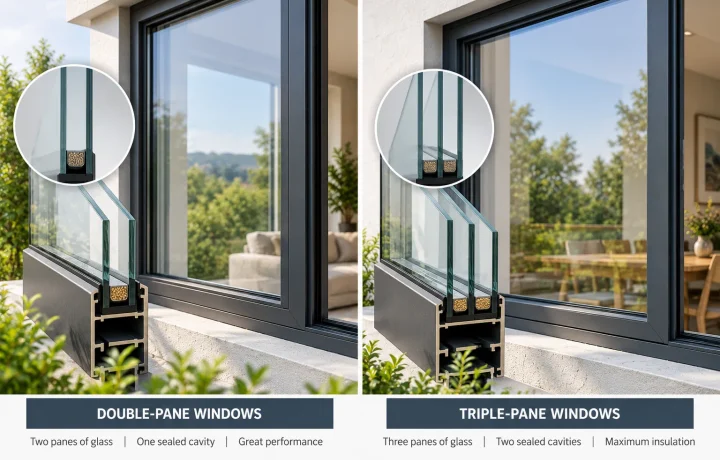
Our double-pane vs triple-pane windows guide explains why pane count, coatings, gas fills, frame construction and installation have to be compared together.
Can You See the Spacer in a Finished Window?
Usually, yes.
Look through the glass near its perimeter and you can often see part of the spacer running between the panes.
But appearance is not a reliable thermal specification.
A black, gray or metallic-looking spacer cannot automatically be classified by sight as high-performance or low-performance.
Some different spacer technologies can look similar once installed.
If performance matters, request the actual product specification.
Is Warm Edge Worth Paying Extra For?
It is easier to justify when one or more of these conditions apply:
- The project is in a cold or mixed climate
- Edge condensation has been a problem
- Indoor humidity is regularly elevated
- Low whole-window U-factor is a priority
- The project uses high-performance double or triple glazing
- Window sizes give edge performance a meaningful influence
- Comfort near large glazed areas matters
- The rest of the window is already thermally well designed
In a cooling-dominated climate, the decision still requires perspective.
U-factor remains relevant because heat can move in either direction through the building envelope, but solar heat gain may be a larger issue on heavily exposed windows.
In that situation, the correct Low-E coating and SHGC may affect cooling loads more dramatically than the spacer upgrade alone.
The correct approach is not to choose one feature.
Build the complete specification.
What Should You Ask for in a Window Quotation?
A quotation that says only:
“Double glazing with warm edge”
is incomplete.
Ask for:
- The exact spacer type or product
- Whether it is a warm-edge system or conventional aluminum
- Glass thicknesses
- Cavity width
- Low-E coating and configuration
- Gas fill, if specified
- Whole-window U-factor or Uw where certified data are available
- SHGC where solar performance matters
- Condensation Resistance rating where relevant and available
- Frame material and thermal-break design
- IGU seal warranty
- Installation and perimeter-sealing scope
This makes it possible to compare two actual windows instead of two marketing descriptions.
What If the Double-Glazed Unit Eventually Fogs?
Fog or moisture trapped permanently between the panes usually points to an edge-seal problem rather than ordinary room-side condensation.
Depending on the window, the solution may involve replacing the insulated glass unit rather than replacing the entire frame.
Our guide to foggy double-pane windows and IGU replacement explains what should be matched when ordering the replacement glass, including Low-E, gas fill, thickness and spacer.
The Bottom Line
The spacer bar absolutely matters.
Its biggest influence is at the edge of the insulating glass unit, where an inefficient spacer can create a colder interior surface and a stronger thermal bridge.
A good warm-edge system can improve edge temperature, reduce condensation risk and contribute to better whole-window thermal performance.
But it remains one component.
Do not buy a window because the quotation contains the phrase “warm edge.”
Compare the exact spacer, Low-E coating, gas fill, glazing build-up, frame, thermal break, whole-window U-factor, SHGC, seals and installation.
That is the specification you will actually live with—not the name printed beside one component.